Discipline
You exit winners early
Your best setups get abandoned the moment the trade moves against you for 30 seconds.
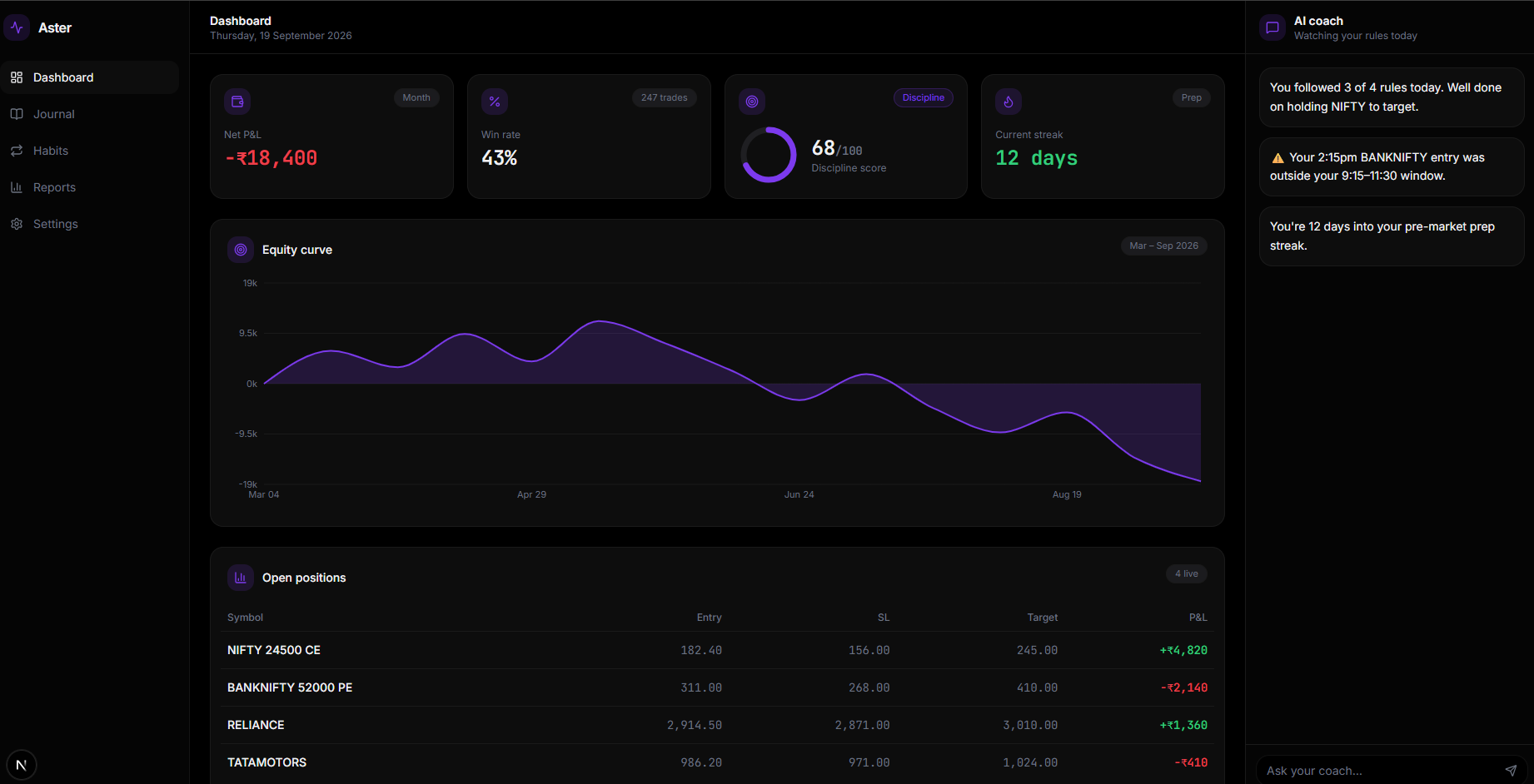
Aster tracks every trade against your own rules and tells you exactly where your discipline is costing you money.
Why traders lose
Your best setups get abandoned the moment the trade moves against you for 30 seconds.
One bad trade becomes five. You know it's happening. You do it anyway.
Without a system holding you to your own words, every loss rewrites the rulebook.
How it works
Export your tradebook CSV from Zerodha Console and drop it in. We parse your full history in seconds.
Our AI reads your trade patterns and builds a personalised strategy and psychology ruleset — entry, exit, risk, and mindset.
Every trade you log gets checked against your own rules. Violations are flagged. Your discipline score updates in real time.
The moments where discipline breaks, told as they actually happen — and what an AI coach built to enforce your own rules does at each one.
CASE 1 OF 7 · PSYCHOLOGY
It's 11:47pm. You're down $340 for the day. You told yourself — out loud, even — "no more trades after a stop-out." You wrote that rule three weeks ago, after a night that looked exactly like this one.
But the chart is moving. It looks like the setup from Tuesday, the one that worked. Your hand is on the mouse before your brain finishes the sentence "just one more."
You're not analysing the market anymore. You're trying to get even. Every trader knows this feeling — and tells themselves it won't happen again, until it's 11:47pm again.
“Your last 3 entries match your revenge-trade signature. This one breaks the rule you wrote yourself: no re-entry within 15 minutes of a stop-out.”
CASE 2 OF 7 · DISCIPLINE
You had a good week. Up 6%. You feel like a good trader. But if you're honest, two of those winners had no business working — you sized up without a plan, held past target because "it kept going."
It paid off. This time. That's the trap: the market doesn't punish bad process immediately. It punishes it eventually, randomly, usually on the trade you were most careless about.
By then you've already convinced yourself the sloppy version of you is the profitable one.
“Discipline Score: 61/100. Your process quality is falling even as your win rate holds — that gap always closes eventually.”
CASE 3 OF 7 · RISK
You've done the scan. Three confirmations, or so you think. You're reaching for the buy button with that specific certainty that only shows up right before a bad trade — the one that feels obvious.
Here's what nobody tells you: the danger isn't in trades where you're unsure — you naturally hesitate there. The danger is in trades where you feel certain, because certainty skips the checklist.
You stop verifying and start assuming. The stop that should be tighter isn't. The R:R that should be 1:2 is actually 1:1, because you talked yourself into an earlier entry.
“RSI confirmation missing. Risk-to-reward is 1:1, not your required 1:2. This trade would violate 2 of your own rules.”
CASE 4 OF 7 · JOURNALING
You've downloaded four journal templates. A Notion one with beautiful formatting. A spreadsheet with conditional formatting you were proud of for a day. Day one, enthusiasm. Day five, a blank tab you feel bad opening.
Here's why it always dies: journaling asks for data entry — the price, the exit, a screenshot — right after a trade, win or lose, which is exactly when you least want to do it.
And the facts were never the hard part. The hard part was always what you were thinking — and that's the one thing you never got to, because you were busy typing numbers you could've exported.
“Entry, exit, and chart logged automatically. All that's missing is what was in your head.”
CASE 5 OF 7 · HABITS
You woke up late. Skipped the pre-market review you usually do. Told yourself "I know the levels anyway, I've traded this pair a hundred times."
By 10am you're down more than you'd normally lose in a week, wondering what went wrong — as if the day started at the open and not four hours earlier, when you hit snooze.
This is the connection almost no trader tracks: the worst sessions don't begin with a bad trade. They begin with a skipped ritual. By the time the P&L is red, the real cause is already twelve hours in the past.
“Your discipline score drops an average of 14 points on days you skip pre-market prep. This has happened 6 of the last 8 times.”
CASE 6 OF 7 · COVERAGE
You're four charts deep into one pair, watching a level that hasn't moved in twenty minutes. Two tabs over, on a pair you haven't glanced at since morning, your exact strategy just lined up — and fired without an audience.
You'll never even know it happened. That's the quiet cost of manual watchlists: you can only watch one thing at a time, so the market trades without you on everything else.
Not because your strategy failed — because your attention is a single, limited resource, and the market doesn't wait for it to be free.
“EUR/USD now meets your Momentum strategy — RSI confirmed, EMA aligned, R:R 1:2.4. You've been focused on GBP/JPY for 11 minutes.”
CASE 7 OF 7 · COACHING
You open a new chat with a generic AI and type your whole trading history again — what pair, what strategy, what happened in March — because it forgot everything the moment the last chat ended.
Halfway through explaining, you give up. It would take longer to catch it up than to just sit with the question yourself.
What you actually wanted was closer to a real coach — someone who was in the room for the bad Tuesday three months ago, who already knows you take worse trades on Fridays.
“Ask it anything: 'Why did I lose money in March?' 'Am I better in the morning or afternoon?' 'Show me every trade where I moved my stop.'”
Illustrative figures for concept presentation, not live product data.